
Blessings
Education that is "Informative and Formative"

Jewish law and tradition require the near-constant recitation of blessings. We say blessings upon waking up and going to sleep, before taking a bite to eat and after concluding a snack or meal. We say blessings to show gratitude; we say blessings after performing basic bodily functions; and we say blessings before studying Torah. Anything we are commanded to do warrants a blessing, and likewise anything we enjoy. Some blessings acknowledge God’s ownership and mastery over the world, while others seem like requests in disguise, as people bestow blessings on one another that express a wish for God’s beneficence. The ubiquity of blessings in our lives is such that the sage Rabbi Meir mandated the recitation of at least 100 blessings each day.1
On one level, reciting blessings, like reciting all prayers, is more about transforming ourselves than it is about anything that God “needs” us to do; as Rabbi Jonathan Sacks wrote, “prayer is the act of turning ourselves into a vehicle for the Divine.”2 And yet, the Talmud also records a remarkable story about the extent to which God Himself values blessings offered to Him by human beings. In this episode, the high priest Rabbi Yishmael ben Elisha entered the Kodesh Ha-Kodashim, the innermost sanctum of the ancient Temple. There he encountered God, who asked him for a blessing. The sage replied,
May it be Your will that Your mercy overcome Your anger, and may Your mercy prevail over Your other attributes, and may You act toward Your children with the attribute of mercy, and may You deal with them more generously than dictated by the letter of the law.3
In response, God nodded His assent. The passage concludes with a moral: this event “teaches us that you should not take the blessing of an ordinary person lightly.”
Beyond the interesting content of this blessing—a point to which I’ll return—this passage highlights the value of a blessing: if God deigns to accept the blessing of a person, then a blessing offered by one person to another should likewise be accepted and valued, no matter how lowly or humble the person offering it. Moreover, the fact God signals his assent to Rabbi Yishmael ben Elisha’s blessing, agreeing to exercise mercy rather than punitive justice, suggests that blessings have some power. This does not mean that all wishes uttered as blessings will come true, but rather that God exists in a relationship with humanity, and He hears our words.
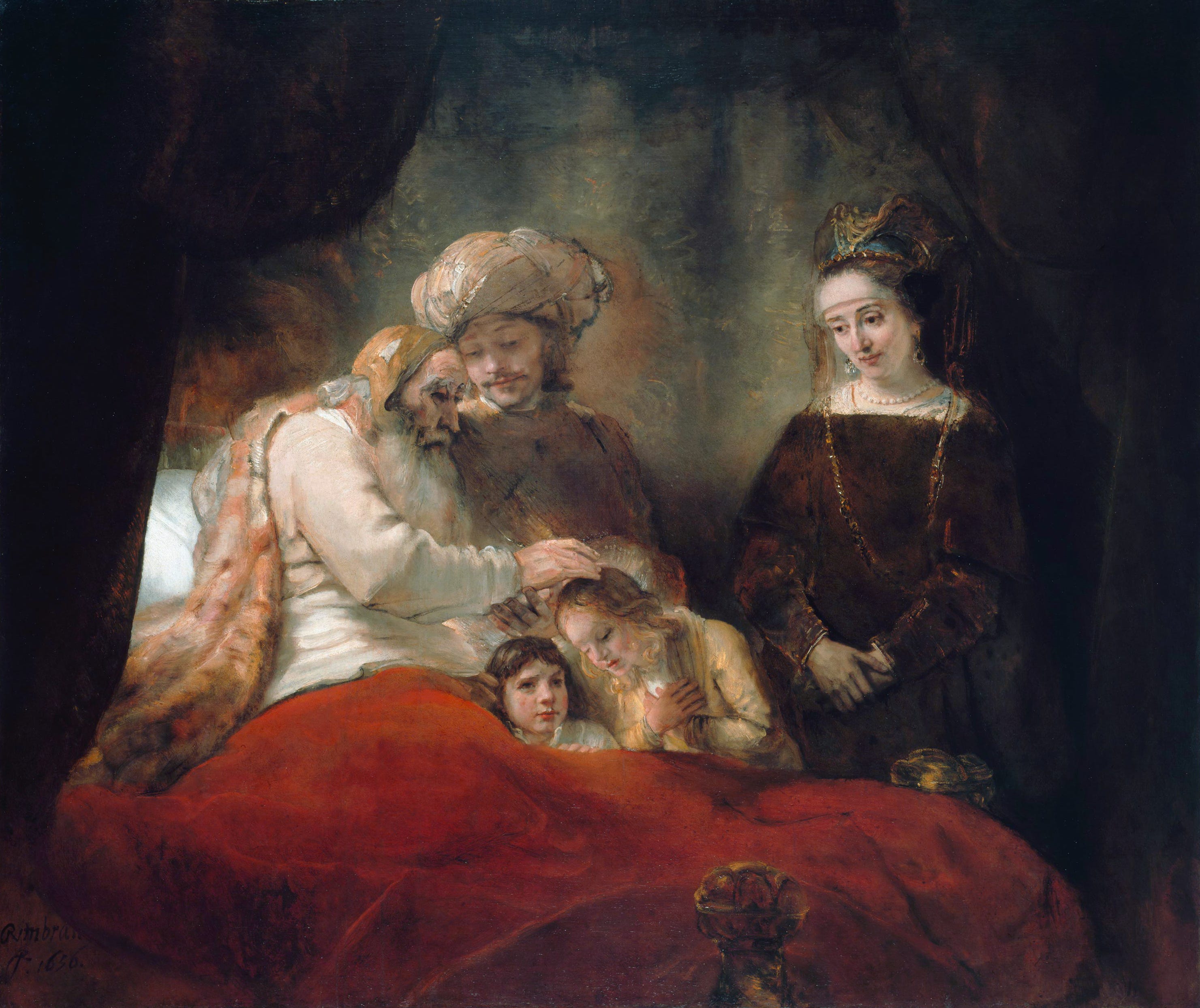
I thought of this passage this past Friday night, when I had the surprising opportunity to offer blessings to a handful of students. My husband, daughter, and I were at a shabbaton (a sabbath retreat) with students in the Honors Programs at Yeshiva College and Stern College. We had dinner on Friday night at the home of a host family, together with over a dozen students and the family of Dr. Shaina Trapedo, Director of the Honors Programs. My husband and I had just given our daughter her blessing, as we do every Friday night, in keeping with the widespread tradition for parents to bless their children on Shabbat. Noticing that the students looked on, perhaps thinking of their own family customs, my husband, with a delighted smile, asked if any of them wanted a blessing. Before I knew what was happening, several of the young women lined up to receive a blessing from me. While they were spending Shabbat away from their own families, they were effectively placing me in a maternal role, calling to my mind the traditional analogy that likens our students to our children.4
In a sense, blessing constituted the unspoken theme of the shabbaton—and, indeed, it has become a theme of the Honors programs as a whole. It is true that Honors students must attain the highest academic achievements to be admitted to the program and continue to do so during college. These requirements have always been in place. But Dr. Trapedo, who only recently assumed directorship of the program, has articulated another dimension: students must cultivate their sense of responsibility and service, channeling their talents to “be a blessing” to all those around them. In this sense, Trapedo’s vision for the Honors Programs emulates the mandate that God offers the patriarch Abraham:
God said to Abram, “Go forth from your native land and from your father’s house to the land that I will show you. I will make of you a great nation, and I will bless you; I will make your name great, and you shall be a blessing.”5
Abraham’s chosenness is inherently bound up with and dependent upon his acceptance of the responsibility to be a blessing to others. His journey is one of growth toward this responsibility; he exercises it both on the individual level through personal sacrifice and on a wider scale, by caring for others who are different from himself and bearing the standard of “what is just and right” for all.6 He is a blessing, and he spreads blessing to others.
In her newly formulated description of the Honors program, Trapedo cites this passage, writing that “Our students embrace the responsibility of what it means to ‘be a blessing’ to others (Gen. 12:2), developing as thoughtful scholars, skilled researchers, and leaders prepared to make meaningful contributions to their fields, communities, and society at large.” I asked Trapedo to elaborate on what this means in the context of a college education. How does participating in challenging coursework and research lead to the acceptance of the mantle of service, of responsibility for others? How can the Honors Programs cultivate students as a source of blessing? She explained:
Education at its best is informative and formative, and this is most possible when students understand they are members of an intellectual community and gather to engage with each other’s ideas in discussion and writing. There is a special alchemy in the Honors courses across disciplines at YU. By design, the professors and coursework require collaborative reflection that cultivates stronger arguments and better scholarship that can positively impact others. In teaching Honors courses on both campuses, I’ve seen Honors students take ownership of their ideas, and sometimes each other’s Google Docs, to help one another reshape the “so what” of a thesis, strengthen claims with credible evidence, and together cultivate a habit of critical thinking, which is arguably the most essential skill needed among college graduates and emerging leaders today. As I tell my students, if the only person who benefits from your Honors diploma is you, we’ve failed. An expansion of your capacity is the next frontier of your gifts. As the blessing given to Abraham continues: “And all the families of the earth shall bless themselves through you” (Gen. 12:3).
In discussing Abraham’s mandate to “be a blessing,” the sixteenth-century commentator Rabbi Ovadiah ben Jacob Sforno connects that passage in Bereishit with the Talmud’s account of Rabbi Yishmael ben Elisha and his encounter with God in the Holy of Holies on Yom Kippur. As Sforno explains, “a true blessing by God is when God rejoices in our deeds and actions. … Here God blessed Abraham with becoming the one who would preach monotheism, including awareness of the benevolence of God, which He extends to all His creatures.”7 What mattered to God was not just that Abraham should be distinct and special, but that he use his distinction and special status to serve others; this becomes clear in the episode in which Abraham argues for the welfare of the people of Sodom, perhaps the lowliest on earth and those least deserving of mercy. When Rabbi Yishmael ben Elisha was given the opportunity for intimate conversation with God on Yom Kippur, he used the opportunity in an Abrahamic way, asking God to have mercy on all of humanity. Thus the distinctive formulation of Rabbi Yishmael ben Elisha’s blessing, and thus God’s agreement to it: God saw the sage using his distinction and special status not for personal gain, but for the welfare of the world.
How, then, can students learn to be a blessing to others? The experience of learning opens their minds beyond the narrow horizons of their childhood, allowing them to understand the experience of others and contribute meaningfully to others’ lives. As I offered my students a modest blessing last Friday night, thinking of how each of them was, in a sense, part of my own family, I thought of how their minds and hearts would grow to bless others.
Rabbi Lord Jonathan Sacks, “The Power of Jewish Prayer,” Jewish Action (Fall 2009), https://jewishaction.com/religion/inspiration/the_power_of_jewish_prayer/.
Berakhot 7a. The story has been retold in the “Tanya Song” by Avraham Fried:
See, for example, Sifrei Devarim 34:4.
The notion of the "blessing" on Friday night is especially interesting. In my "fancy" siddur, there was a citation (I believe from the Yaavetz) about hos the parent is a "conduit" upon giving a blessing on Friday night AND there can be little that is more inspiring in terms of the Mesorah then when a "parent" is not only "blessing" his / her own children -- but also their spouses ... and then THEIR children (i.e., the grandchildren of the one giving the blessing)... I think that this "inspirational" aspect of the blessing could be developed further?
Your own experience of blessing those whose parents are not present is (for me) an echo of the story of the Sanz-Klauseberger Rebbe at the end of WW-II. It was Erev Yom Kippur and the Rebbe was "getting ready" for this awesome day... And, then a girl approached him asking for a b'racha because her father was no longer alive. The Rebbe stopped whatever he was doing and gave her a heartfelt b'racha ... and then another girl approached ... and another... and another....
This incident that I read about concluded that the Rebbe never completed "his own preparations".... except that I like to think that he DID complete his own "preparations" in the most meaningful way...