
Academic Questions
Lessons from the Age of Galileo

There is a joke that is sometimes attributed to the advice columnist Dear Abby, though I haven’t been able to find the original source. Reportedly asked, “Why do Jews always answer a question with a question?,” Dear Abby replied, “How should they answer?”
While jokes about Jews and their habit of asking questions abound, there is a serious aspect to this phenomenon: linguists have suggested that the dialogic patterns of the Gemara—its extensive questioning and argumentation—have seeped so deeply into Jewish culture and thought that they have even influenced Yiddish and Yiddish-inflected speech. As linguist David Kraemer explains,
The most obvious quality [of the Talmud’s] deliberations, whatever their outcome, is their assumption that stated opinions must be repeatedly tested and challenged, difficulties and internal inconsistencies repeatedly identified and resolved. This is the argumentational quality of the Talmud par excellence. … All of the necessary elements to argue for the plausibility of the influence of Talmud on Jewish speech are present: the physical Talmud itself, the proliferation of its study, the growth of its prestige, the ubiquitous relationships of its students and other Jews—all of these combined to form the path by which the Talmud could leave the study hall and find a place in common Jewish parlance.1
Asking questions is a habit that has remained in Jewish speech patterns and habits of thought.
Asking questions is likewise a fundamental aspect of academic life: research is not just about gathering facts; it is all about asking questions. As students, we learn to participate in ongoing discussions and debates, using the vocabulary and methodologies of each field to discipline and shape our minds in particular ways. Far from being restrictive, this disciplining of the mind teaches us to perceive problems, inconsistencies, points of friction—and to ask the constructive, generative questions that will yield new answers. As professors mentor our students, we do not ask them merely to memorize information or repeat knowledge that others already hold. Instead, ideally, we ask students to master knowledge and skills and then go farther. We ask them to try new ideas, test their hypotheses, seek feedback on their work, and share it in ways that will advance the field. In this way, students join the process of creating new knowledge.
This process reflects my own journey into the world of research. Raised in an academic household, I knew from a young age that I wanted to become a college professor. But strangely, it wasn’t until two years after I earned my PhD in music history that I felt really at home in the world of research.
Years earlier, I had become fascinated with music from early seventeenth-century Italy. Far from the caricature of “classical” music as restrained, neat, and orderly, the music of this period sounded wild and rhapsodic, open, spontaneous, curious, and inventive, as if it sought to break all the rules. One theme or musical idea flows fluidly into the next, as the composition seems to unfold and develop based on the rhapsodic imagination of the performer.
As a harpsichordist, I especially grew to love the instrumental music of this period—music that, in contrast to song and opera, uses only instruments like the violin, recorder, harpsichord, and lute to be expressive and move its listeners’ emotions. In fact, the turn of the seventeenth century saw the rise of the first extended body of instrumental music in western history.
Listen to the two audio clips below to get a sense of what some of this music sounds like. (Note the self-consciously innovative title of the “Sonata called the moderna,” the “modern one,” by the Italian Jewish composer Salamone Rossi—a figure I’ll return to in the future.)
Dario Castello, Sonata decima (1629), live recording by Quicksilver Baroque:
“Sonata detta la moderna,” (1613?) by the Jewish composer Salamone Rossi, recorded by Europa Galante:
The PhD dissertation that I wrote about this music was… fine. It got the job done. It gathered sources and ideas, offered descriptions of this instrumental music, and compared it with vocal music of the same period. But I was left with the lingering sense that I had not really understood the music on a deeper level: Why did instrumental music arise particularly in this time and place? How could we explain this new phenomenon and its self-conscious “modernity”? Why did it affect listeners then, and why does it continue to affect me and other enthusiasts today?
It was not until a couple of years after earning my PhD—and countless additional hours of reading, listening, and writing—that I realized how I could answer these questions, and this thesis became my first book. In contrast to earlier instrumental music, in which instruments were used to imitate the human voice, I argued that this music embraced the technology of the instruments themselves. I started to think of musical instruments as just like other instruments—telescopes, microscopes, barometers, clocks, pens, paintbrushes—which were used to explore the world, to ask questions of the world. These musical questions might be about the nature of the instrument itself: What can the instrument do? What can instrumentalists do after having been trained to use the instrument to the point where playing it becomes second nature? Or these questions might ask about the ability of instruments to represent the natural world and to move human emotions.
At the very same time this music was being written, Galileo Galilei used one of his own instruments—a newly refined, high-powered telescope—to look at the night sky. (Galileo also played a musical instrument, the lute.) He might have had an idea of what he would see, but he didn’t know for sure. He used his telescope to wonder, to probe, to challenge, and to ask.2 What he saw flew in the face of centuries of received wisdom, drawn from Aristotelian philosophy and refracted through the doctrines of the Catholic church. While these authorities had long held that the heavens were perfect, Galileo saw through his telescope that the moon was pockmarked, littered with hills and craters—apparent “imperfections.” Having witnessed these features of the moon’s surface, he set about using his skills as an artist and draftsman to share his discoveries with a community of scientists, philosophers, and wealthy patrons. Galileo’s drawings were published in a book presenting his discoveries, the Siderius nuncius (Starry Messenger).
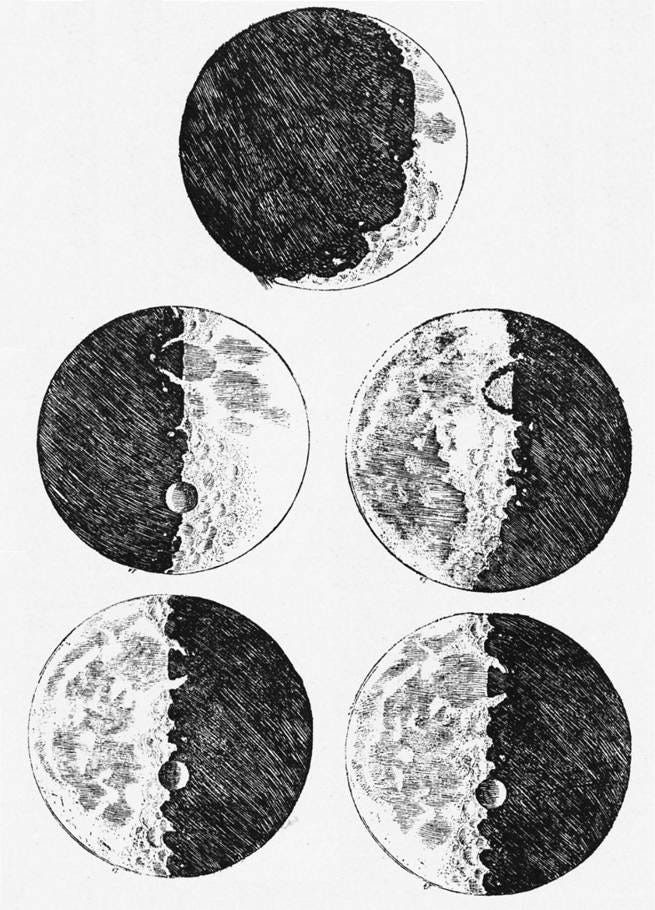
Let’s analyze the episode with Galileo and his revolutionary conclusions about the moon. What steps did this involve?
He developed expertise in existing fields. He apprenticed as an engineer and picked up local wisdom about lens making. He learned to draw.
He studied what others had said about astronomy.
He formulated questions and approached his own work with an open mind. When he used his instrument, the telescope, he might have had theories about what he would see, but he did not know for certain. He wondered; he asked questions; he tried to understand and interpret his observations.
He recorded his observations by writing about them and drawing what he saw.
Open-minded questioning was crucial to Galileo’s discovery. He remained open to changing his mind based on his observations. His use of the telescope represented a new conception of what instruments were for. The word “instrument” means nothing more than “tool.” The category can encompass, for example, a blacksmith’s tools, used to make an object like a horseshoe, or a compass or sextant used by sailors as they navigate the sea. The idea of using a tool—in this case, the telescope—without a predetermined purpose was new. It was one of the many revolutionary ideas that contributed to the Scientific Revolution.3 No longer content to repeat the knowledge already accepted or the processes already established, figures like Galileo, Isaac Newton, and René Descartes created their own scientific paradigms, new ways of thinking, and a rigorous, falsifiable approach to testing their ideas and reaching conclusions. Their science was based on questions.
As I worked through the instrumental music of early seventeenth-century and learned more about the science and systems of knowledge from the same period, I found that this process of open-ended inquiry formed a driving force behind much of the music that fascinated me. I had always heard this music as inventive, exploratory, and full of wonder and curiosity. Now I was able to develop a new argument that connected that sense of exploration and curiosity that I heard in the music to a broader culture of exploration and curiosity that dominated the intellectual life of early seventeenth-century Italy. I wrote a book in which I argued that the rise of the first extensive repertoire of instrumental music in the European tradition was linked to a new conception of instruments as a broad category—the tools and machines that people used to mediate between themselves and the world around them. Musical instruments, too, were tools for asking questions.4
Looking back, I recognize a happy irony in the way my journey into research unfolded. I learned to ask questions by studying early modern scientists and artists who created new ways of asking questions.
While I have since gone on to do a lot of research on music in Jewish culture and history, this first big project did not bear obvious connections to my Jewish life and commitments. Yet it has certainly shaped the ideals that I strive for as a dean at Yeshiva University, including the promotion of research, the cultivation of open-ended questioning among our students, and my conviction that the habits of questioning developed in the Beit Midrash—the habits of Talmudic discourse—can be applied rigorously and enthusiastically to the academic enterprise across the disciplines. Our students, who develop habits of questioning from the cradle, have a lot to offer to the world of academic questions.
David Kraemer, “Talmud Talk and Jewish Talk,” In Geveb: A Journal of Yiddish Studies (June 16, 2020), https://ingeveb.org/articles/talmud-talk-and-jewish-talk.
The literature on Galileo’s empirical epistemological approach to science and its relationship to the arts is vast. My thinking has been shaped especially by Jean-François Gauvin, “Instruments of Knowledge,” in The Oxford Handbook of Philosophy in Early Modern Europe, ed. Desmond M. Clarke and Catherine Wilson (Oxford: Oxford University Press, 2011), 315–37; Eileen Reeves, Painting the Heavens: Art and Science in the Age of Galileo (Princeton, NJ: Princeton University Press, 1997); and Antonio Malet, “Early Conceptualizations of the Telescope as an Optical Instrument,” Early Science and Medicine 10, no. 2 (2005): 237–62, among others.
The classic work on the Scientific Revolution as a dramatic change in systems of knowledge is Thomas S. Kuhn, The Structure of Scientific Revolutions (Chicago, IL: University of Chicago Press, 1962). While more recent literature has shown that the Scientific Revolution of the seventeenth century progressed in more nuanced ways than Kuhn’s account acknowledges, its basic framework still serves as a useful starting point for understanding how intellectual movements and epistemological models develop and change.
Rebecca Cypess, Curious and Modern Inventions: Instrumental Music as Discovery in Galileo’s Italy (Chicago: University of Chicago Press, 2016).
A few half-notes, as it were – the material here is very thought-provoking, and I'd like to revisit it more carefully, but in the meantime:
Questions – in talmudic discourse / Jewish speech patterns, & in science & knowledge production in general, are only half the picture (although the emphasis on questioning / epistemological anarchy is a trope both in portrayals of yiddishkeit – usually [semi-]secular – and pop-Kuhn / Feyerabendesque accounts of science). This is particularly noticeable from a musical perspective, I think; Kahan-Newman's phenomenal research – which Kraemer relies on – provides ample examples of how the q-&-a format resolves in terms of pitch. The resolution of questions is also invested with an eschatological weight [the same way that the resolution of musical / poetic forms can be; I'm thinking of Agamben's argument that the sestina is made possible by Paul's adaptation of Jewish thinking about messianic time] – the drash that teyku is roshei-teivos for תשבי יתרץ קושיות ואיבעיות is probably the most famous & on-the-nose example. But when it comes to most questions, we aren't waiting for Eliyahu hanavi, and we encounter and inherit those answers just as much as we do the questions, if not more. (Beyond the fact that the gemara-nign / Jewish speech patterns encode not just questions but answers and argumentation, the very talmudic rhythm of question-and-answer can serve to lull the listener / reader / student into a sense of resolution / satisfaction / complicity which actually draws less criticism than bald assertion of premises would.)
Agav, the gemara-nign and associated speech patterns are endangered in many habitats, owing largely to the iyun revolution; iyun spends much less time on talmudic sources than previously prevalent Jewish ways of learning, focuses less on the argumentation and rhythm of the sugyos and more on conceptual analysis, and most importantly lends itself to soundless scanning of text rather than reading or chanting aloud. Obviously questioning survives and thrives in iyun as well, but in a very different way, and one which possibly affords less opportunity / temptation / challenge to question first principles than older styles of Jewish learning.
Finally, both with regard to Galileo's methodology and in the context of Talmudic/Jewish rhetoric / argumentation, I wonder if C.S. Peirce might be the salient reference rather than Kuhn; his account of abduction is more or less the product of the study of early modern scientific discoveries, Galileo's included, and emphasizes the role of the fundamental assumption at the heart of their methodologies: that the universe is built of the same stuff as we are (in a Leibnizian sufficient-reason sense), and that our intuitions are therefore a good guide to it, though they require refinement through trial and error. His account is, I think, a good corrective to the sort of epistemic anarchism one often encounters in discussions of paradigm shifts, and probably also would shed light on Talmudic rhetoric & argumentation.
Without going into detail here, you may be interested in the idea (found in the writing of R. Schwab ZT"L) how music was NOT affected at the time of the "Tower of Bavel" when G-d "confused" the *spoken* language(s) of humanity