
Leafing Through History
What Do Students Gain from Studying Rare Books?

What do we do with books that are no longer fit to be used? The question can be answered in various ways, depending on one’s perspective. Since the advent of electronic books—especially older books, for which full texts are increasingly online—the leaders of many public and scholarly libraries have debated how many physical books to keep. Some argue that physical libraries should be conceived of as spaces for communal study and gathering, rather than as spaces to store physical books and make them accessible.1
In Jewish tradition, holy books that are damaged or unneeded are afforded the respect of Geniza (burial) rather than destruction.2 This is how the Jewish community of Fustat, or Old Cairo, handled hundreds of thousands of documents between the sixth and nineteenth centuries CE; indeed, the community deposited virtually anything with Hebrew letters into the Geniza, whether the texts were considered holy or not. Thought to be useless, the documents were dropped into a windowless room, accumulating layers of dust and infestation by insects. British and European scholars entered the room in the nineteenth century, taking away countless texts for preservation and study; these have now been distributed among libraries around the world. Once seemingly abandoned and useless, the fragments from the Cairo Geniza have come to be understood as vital documents attesting to the history, religious life, and governance of Mediterranean Jews over a period spanning centuries. Today, with the help of digital tools, scholars have begun to piece together fragments from the Cairo Geniza that have been distributed to libraries around the world.3
Yeshiva University’s Libraries hold two fragments from the Cairo Geniza: first, an excerpt of the commentary on the biblical book of Isaiah by Rav Saadia Gaon, and second, a fragment of a medieval piyyut (poem), “Le-Yoshev Tehillot” (He Who Dwells in Praises), composed by the renowned poet Eliezer Kallir and copied into this manuscript likely in the eleventh century. The Kallir fragment has been studied extensively by Shulamith Berger, Curator of Special Collections at YU’s Mendel Gottesman Library.4
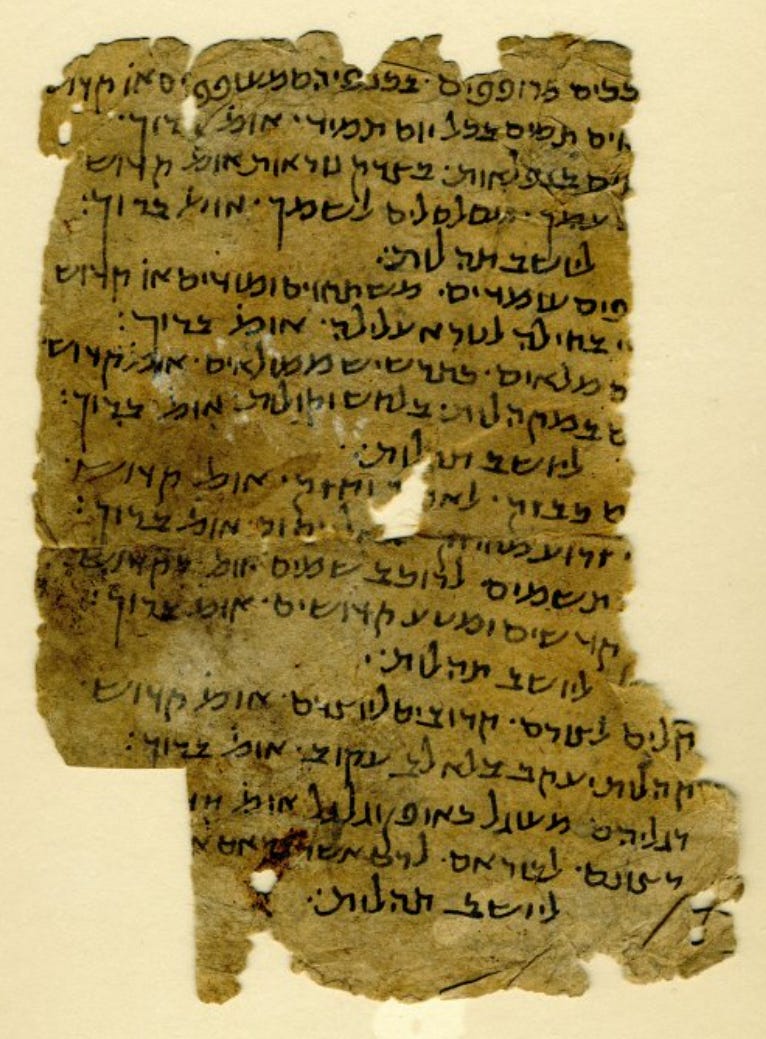
I met with Berger, as well as faculty member Rabbi (soon-to-be Dr.) Yaakov Taubes and one of his students, Matthew Minsk, to discuss their experience teaching and learning about the Geniza fragments and other rare treasures from YU’s Special Collections Division in the context of a course that Taubes offered in Spring 2026. With rabbinic ordination from YU’s Rabbi Isaac Elchanan Theological Seminary, Taubes has written his PhD dissertation at the institution’s Bernard Revel Graduate School of Jewish Studies on the history of the medieval Jewish book. His research addresses questions including: How were Medieval Hebrew books organized? When did they start including tables of contents? When did they introduce indexes? What about chapter divisions and headings? At first blush, these questions might seem peripheral, even trivial, to telling the story of Jewish writing, reading, and books. Yet these were the features that made books increasingly accessible and easy to navigate. A similar goal—making rare Jewish books accessible to students—motivates Taubes to introduce his students to the Special Collections at Mendel Gottesman Library.
My meeting with Berger, Taubes, and Minsk was itself a mini-course in the holdings of the Special Collections. To start, they introduced me to one of the oldest known copies of the She’iltot of Rav Ahai Gaon (Aha of Shabha, 680–752).5 Pioneering a format that would be emulated by countless later writers, including many today, the She’iltot organizes discussions of halakhah around the cycle of weekly Torah readings, thus connecting biblical exegesis with practical law. First composed in the eighth century CE, the She’iltot of Ahai Gaon may be the earliest extant rabbinic work composed after the completion of the Talmud; it was widely cited by later writers and understood as authoritative.
In addressing the She’iltot and other books, Taubes and Berger ask students to read closely, examining handwriting, construction, and the use of marginal material like catch words. They emphasize that how a book is perceived is not due solely to its contents, but also to its form and presentation. Authors who made their work accessible to a lay readership, as opposed to elite specialists, generally saw their work achieve wider success.
This was surely true of the Sefer Mitzvot Katan (Little Book of Mitzvot, known by its acronym, “SeMaK”) by Isaac ben Joseph of Corbeil (d. 1280), a poetic abridgment of the Sefer Mitzvot Gadol (Great Book of Mitzvot) by Moses ben Jacob of Coucy.6 The SeMaK combines Jewish laws with aggadic ideas; it includes only those halakhot that are relevant in the age after the destruction of the Temple in Jerusalem. The SeMaK organizes halakhot according to the seven days of the week as well as under the rubrics of the Ten Commandments; its design was intended to prompt ordinary Jews to recite the halakhot ritually, thereby internalizing their details and learning how to follow them in everyday life. This ritualization meant that the SeMaK was often appended to the siddur (daily prayerbook) and bound with other texts used for ritual purposes. Such is the case with the copy held in the Gottesman Special Collections, which includes the siddur as well as the text of a divorce document and marginal notes by Rabbeinu Peretz ben Elijah of Corbeil.7
The texts of the She’iltot and the SeMaK are now readily available online through websites such as Sefaria.org, HebrewBooks.org, AlHaTorah.com, and others, and these manuscripts, along with countless others, have now been digitized and can be read easily from the comfort of one’s home. Some of these websites scan the text in a familiar form, preserving the tzurat ha-daf (image of the page) that has come to take on its own meaning. Others reconfigure the text, interpolating translations or providing links to commentaries that do not ordinarily appear on the page. All this being the case, what is the purpose of introducing students to the books themselves? There are practical reasons, as Berger noted: “I see something on the screen, and it can be any size, any shape. Holding it in my hands is different. I can see how books became popular and accessible.” As a student encountering rare books for the first time in Taubes’s class, Minsk noted that the field can be overwhelming. Knowing that Berger has devoted time to studying the manuscripts in the Mendel Gottesman Special Collection sets an example: “There are hundreds of thousands of Genizah fragments out there, but Mrs. Berger and others have been able to write about our specific fragments. Starting here will prevent us from being overwhelmed by everything that’s out there.”
In addition to these practical factors, Berger emphasized her goal of inspiring a sense of wonder—a “wow factor”—in students who visit the collection. She drew an analogy to an experience that she had one morning years ago in synagogue. Following the reading of the Torah that morning, when the Torah scroll was lifted for the entire congregation to see—a ritual that takes place every time the Torah is read publicly—a woman sitting next to her gasped. She had never seen the inside of a Torah scroll before. While that would not happen among the student population at Yeshiva University, Berger seeks to inspire a similar sense of wonder in the students whom she introduces to rare books.
Minsk agreed and described how that sense of wonder gave way to curiosity: “When older books are actually in front of you, there’s more of an inclination to play with it, to look through it. Curiosity can motivate you to look at it in new ways.” This resonates with my own experience handling old, rare books. As a scholar, I have sometimes handled rare books with a view to answering a specific question. More often, however, I have gotten the book in front of me and wondered, simply, “What can I learn by leafing through it?” This has led to realizations about how the book was used, or how its owners understood it or related to it, which have then informed my overall interpretation of the past.
For Taubes, the need to introduce students at Yeshiva University to the Jewish texts in the Gottesman Special Collections is still more pressing:
In our yeshiva studies, we talk about how we are studying books that are the same as those used by our ancestors. But seeing what those seforim (books) looks like—and how, over time, we have tried to make books more accessible, more user-friendly—shows our students that our tradition is not stagnant. Even when we have kept the words and ideas the same, we have tried to make books better and more user-friendly in their form.
Taubes went on to draw wider lessons about the study of Jewish history:
Not everyone going through a Jewish history class is going to become a historian. But when it comes to Jewish history, we should be able to understand and assess claims that have been made by scholars and lay people. How do scholars reach their conclusions? What is good history? What is good scholarship? And what is fake news?
Coming face-to-face with the artifacts of history helps to illuminate the process by which history is made, the standards of evidence that are required, and how we must interrogate assumptions to make sure our understanding is both grounded in evidence and flexible enough to take in new evidence when it emerges. In this sense, the physical space of the Mendel Gottesman Library at Yeshiva University serves a wider purpose, as Taubes explained:
The Gottesman Library occupies a distinctive position at the intersection of the modern academic research library and the traditional beit midrash / otzar seforim [study hall / book collection]. Roshei Yeshiva and rabbinic students make extensive use of its collections, which include both contemporary works of halakhah and derush [exegesis], as well as newly edited and reissued classical texts. At the same time, Jewish Studies faculty and graduate students rely on its comprehensive academic holdings, which are continually expanded and updated in accordance with scholarly needs.
The atmosphere of the library is similarly hybrid: it combines the quiet austerity of a research library with the energy and vibrancy of a Beit Midrash. The library staff possesses expertise across both domains and provides guidance in locating both rabbinic and academic materials.
In its hybrid status, combining the ethos of the Beit Midrash with the expansiveness of an academic library, the Mendel Gottesman Library may be unique in the world. It attracts scholars from across the religious spectrum, and it provides students with a point of entry to both worlds. Minsk described how the use of physical books in the context of the library motivates him to persevere, to learn more: “As an undergraduate student, I find that open stacks and physical books make research feel real—like I’m accomplishing something. Going through the effort of research with a stack of books piled up on a table makes me feel involved in the process of learning.”
My mini-tour of the Special Collections continued with numerous additional volumes and fragments. Among these were fragments that had been defaced when they were determined to be unusable: instead of being placed in Geniza they were used in the binding of other volumes. Painstakingly removed from these bindings in recent years, the pages had been preserved and are now available for display and study. As Berger explained concerning one of these fragments, “The old adage, don’t judge a book by its cover, fails to consider that the cover itself may tell a story.”8 As Berger, Taubes, Minsk, and I looked at these fragments together, I caught a glimpse of how the these and so many other rare books would shape the stories of countless students and scholars yet to come.
Among countless examples, see Pathum B. Rathnayake, “End of an Era? How Libraries Are Thriving in a Screen-Obsessed World,” Information Matters (September 17, 2025), https://informationmatters.org/2025/09/end-of-an-era-how-libraries-are-thriving-in-a-screen-obsessed-world/.
Colin Schultz, “Powerful Computers Are Piecing Together 1,000 Years of Jewish Chronicles,” Smithsonian Magazine (May 28, 2013), https://www.smithsonianmag.com/smart-news/powerful-computers-are-piecing-together-1000-years-of-jewish-chronicles-82094942/.
Shulamith Z. Berger, “Sacred Scraps: Tales of the Cairo Genizah” (October 10, 2024), https://www.yu.edu/news/library/sacred-scraps-tales-cairo-genizah. See also Shulamith Berger, Joseph Ginsberg, and Aaron Koller, “A Fragment of a Piyyut by Qilliri for Yom Kippur from the Collection of Yeshiva University,” Fragment of the Month, Cambridge University Library (October 2024), https://www.lib.cam.ac.uk/collections/departments/taylor-schechter-genizah-research-unit/fragment-month/fotm-2024/fragment-8.
Yeshiva University Special Collections, Ms. 1371, digitized at https://digital.library.yu.edu/object/digital7280#page/1/mode/2up.
The book’s proper name was Sefer Amudei Golah (Pillars of the Exile), indicating that observance of the mitzvot sustain the Jewish people during their exile.
Yeshiva University Special Collections, Ms. 1069, digitized at https://digital.library.yu.edu/object/digital7267#page/1/mode/1up.
Shulamith Z. Berger, “Cover Story: Remnants of Nahamu Hidden in a 13th-Century Manuscript Fragment,” YUNews (August 2, 2021), https://www.yu.edu/news/cover-story-remnants-of-nahamu-hidden-in-a-13th-century-manuscript-fragment.